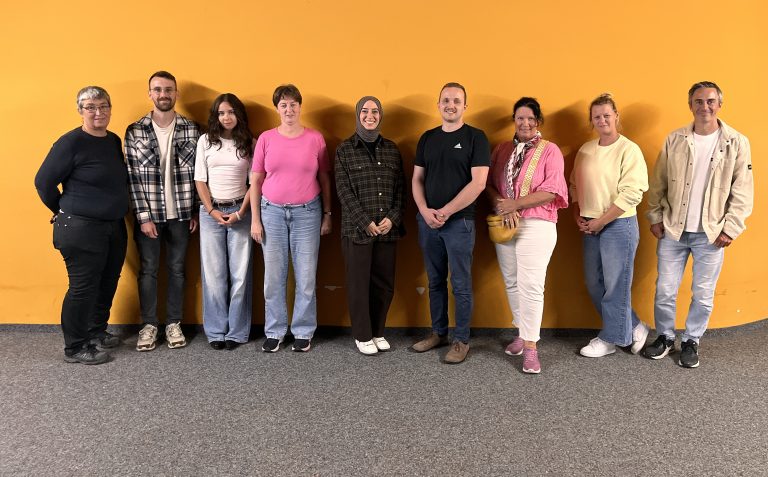

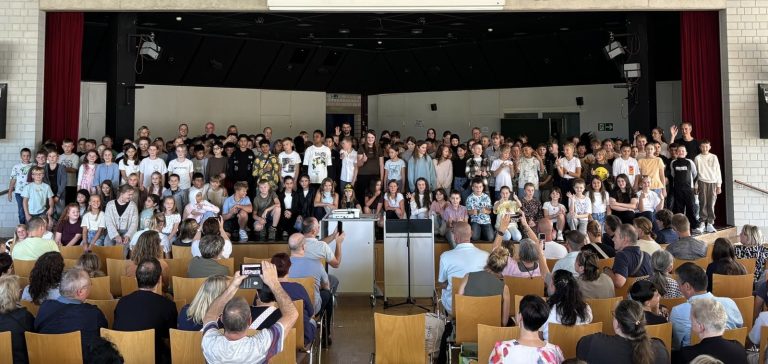

First study trip of the Johannes-Brenz-Gemeinschaftsschule Schwäbisch Hall.
On Sunday, 7 May, the Kursstufe I of the Johannes-Brenz-Gemeinschaftsschule left its familiar surroundings in Schwäbisch Hall with packed suitcases to go on a study trip as the first class in the school’s history. Supported by the Erasmus+ education programme of the European Union, their destination was to visit the partner school in Zamość, near the Ukrainian border in Poland. After a half-day journey by train and plane, they arrived at their first stop, Kraków, together with the accompanying teachers Parzival Held and Achim Knaak.
The next day, the pupils from Schwäbisch Hall met pupils from Zamość there and, led by a city guide, explored the second-largest city in Poland. The following day, the journey continued to Zamość. While the Polish Year 12 pupils initially took the back seats of the coach and the visitors from Schwäbisch Hall enjoyed the landscape from the front section, first conversations began towards the end of the trip.
The ice was finally broken the next day during group games and getting-to-know-you activities. The pupils lined up without speaking according to shoe size, hair colour or eye colour, and together tied a loop with a large ribbon without letting go of it. During the mutual portrait painting of initially unfamiliar peers, everyone then discovered that humour is a means of quickly overcoming initial cultural and language barriers. Fittingly, on Europe Day, 9 May, the Polish headteacher Bogusław Klimczuk then gave a talk about Robert Schuman, the founding father of the idea of a united Europe. Afterwards, the young people worked together, through interviews, on what it means for them to live in the EU and to what extent they identify with it. The tours of the partner school and partner town, as well as the joint volleyball match in the evening, rounded off a successful day in the spirit of international understanding.
This laid the trusting foundation for canoeing and hiking together the next day in the Roztocze National Park, and the sense of community could continue to grow. A barbecue at midday rounded off the day trip. Looking back, many pupils were amazed at the diversity and beauty of nature in south-eastern Poland.
Things became somewhat more formal the next day with a visit from the mayor of Zamość, Andrzej Wnuk, who told the group a great deal about the town, the Lublin Voivodeship and, above all, about the cooperation with Germany and especially the twin town of Schwäbisch Hall. An open question-and-answer session and a group photo in front of the town hall concluded the meeting. Afterwards, the German and Polish pupils continued by coach for a guided tour of the Majdanek concentration and extermination camp in nearby Lublin.
The Polish and German pupils spent their last evening together in Zamość, before the German group continued to Warsaw the next day for a city tour. This was led by Bogusław Klimczuk himself, who accompanied the German visitors in a friendly way to the most important sights. The highlights were the view of the city panorama from the Palace of Culture and Science and a leisurely stroll through the streets and lanes of the Old Town. Along the way, he gave the group valuable insights into the culture, for example when he drew their attention to the many smartly dressed Abitur candidates.
On Sunday, 13 May, after an intensive study trip full of new impressions, it was time to say goodbye. The train took them back from Warsaw to Schwäbisch Hall. Some used the time on the journey to do schoolwork, because next year they too will face their Abitur exams for the first time at the Johannes-Brenz-Gemeinschaftsschule. But first, they would like to plan another class trip together. Who knows where the next one will go? They certainly have the mobile numbers of their Polish friends. In any case, Bogusław Klimczuk and Achim Knaak agree that there should be another study trip to Zamość for the next Year 12 pupils.