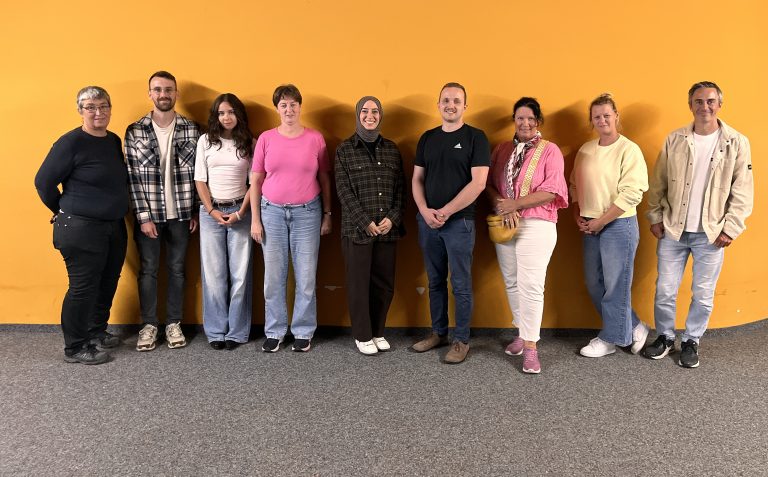

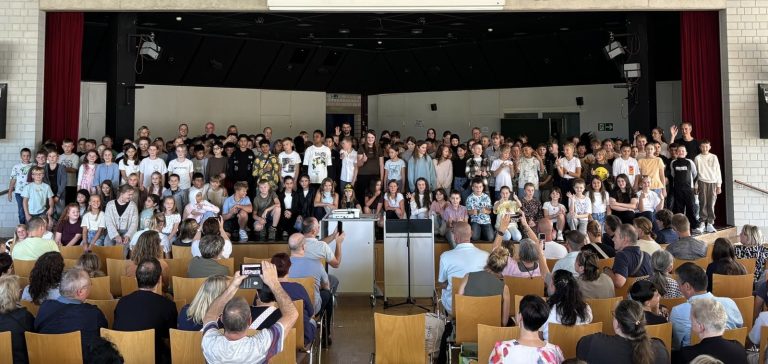
We, class 11b of the Johannes Brenz Gemeinschaftsschule, were given the chance to watch the play „Die Berufung“. It was performed at the Neuen Globe, written and directed by Jennifer Sittler and played by the actor Christian Wincierz.
The play is about Gene, who is also played by the director Jennifer Sittler. Gene has found old documents about his grandfather Edward Vieth Sittler, who emigrated from America to Germany at the age of just 21 and renounced his American citizenship. Gene now wants to find out much more about the life of his grandfather Edward. And so he begins in New York to uncover the truth about the past and realises, among other things, that Edward supported the National Socialists through propaganda radio broadcasts.
Journeying back into the past, to the hidden sides of his family history, left us as an audience completely impressed. The first impression of the play was, for us pupils, rather surprising. At the start we saw an almost empty stage, with a screen and, in the background, a kind of scaffolding, and there was only one actor to be seen, Christian Wincierz. There were several roles in the play, yet remarkably, Wincierz took on not only his main role of Gene but also the other roles of Margaret and Edward Sittler.
Some of us wondered how a single person could perform an entire play without it becoming boring. But by the end of the performance we were more than thrilled and surprised at how a single person managed to deliver such an accomplished performance, and at the same time immersed herself so completely in the roles of the play that, as a member of the audience, you forget you are sitting in a theatre and that the actor is taking on a role. At first the author’s plan was to deliver a narrative, like a lecture. But while writing, many emotions surfaced because of her personal connection to the subject. She gradually brought more of these into the script. Through the narrative perspective she finally chose, the feelings could be portrayed in a way that felt more than authentic. Gene’s facial expressions and gestures were also very expressive and often made understanding easier.
It was especially interesting to witness how the emotions changed over the course of the play. It was also gripping to experience the thoughts of a person who has confronted her family history and, instead of keeping it secret, informs us about this important subject. This makes our generation think about it again in a different way than dry accounts and mountains of facts and dates from history lessons. That is why we, the Year 11 class of the Johannes-Brenz-Gemeinschaftsschule, would like to warmly recommend this excellent play to anyone who wishes to approach German history from a personal perspective, presented in a way that is exciting and emotionally gripping.